1. Introduction to Surfing Munich – river surfing and beyond
Munich offers a unique standing river wave surfing experience that is world-renowned. Two waves are located in Munich’s city center within the Eisbach River in the English Garden (Munich’s biggest inner-city park). In addition, the Floßlände in the south of the city is another free-to-surf river wave, considered best for beginners. Munich first established “river surfing” and then made it respectable which is the reason why Munich is considered the Hawaii of river surfing. In addition, Jochen Schweizer offers a perfect indoor city wave, south of Munich, and in 2024 SURFTOWN® MUC opened its doors: a 20,000 sqm artificial surfing facility in the north of Munich (next to the airport) that is unique in Europe.
2. Munich Standing Waves + Wave Park
The surf region Munich provides three standing river waves that are free to surf for everyone, one perfect indoor surfing standing wave, and since 2024 a modern wave park with a lot of different types of waves for all different types of surf abilities. Read on to get the details about each and every wave that awaits to be surfed in Munich.
Eisbach E1 – the infamous river wave
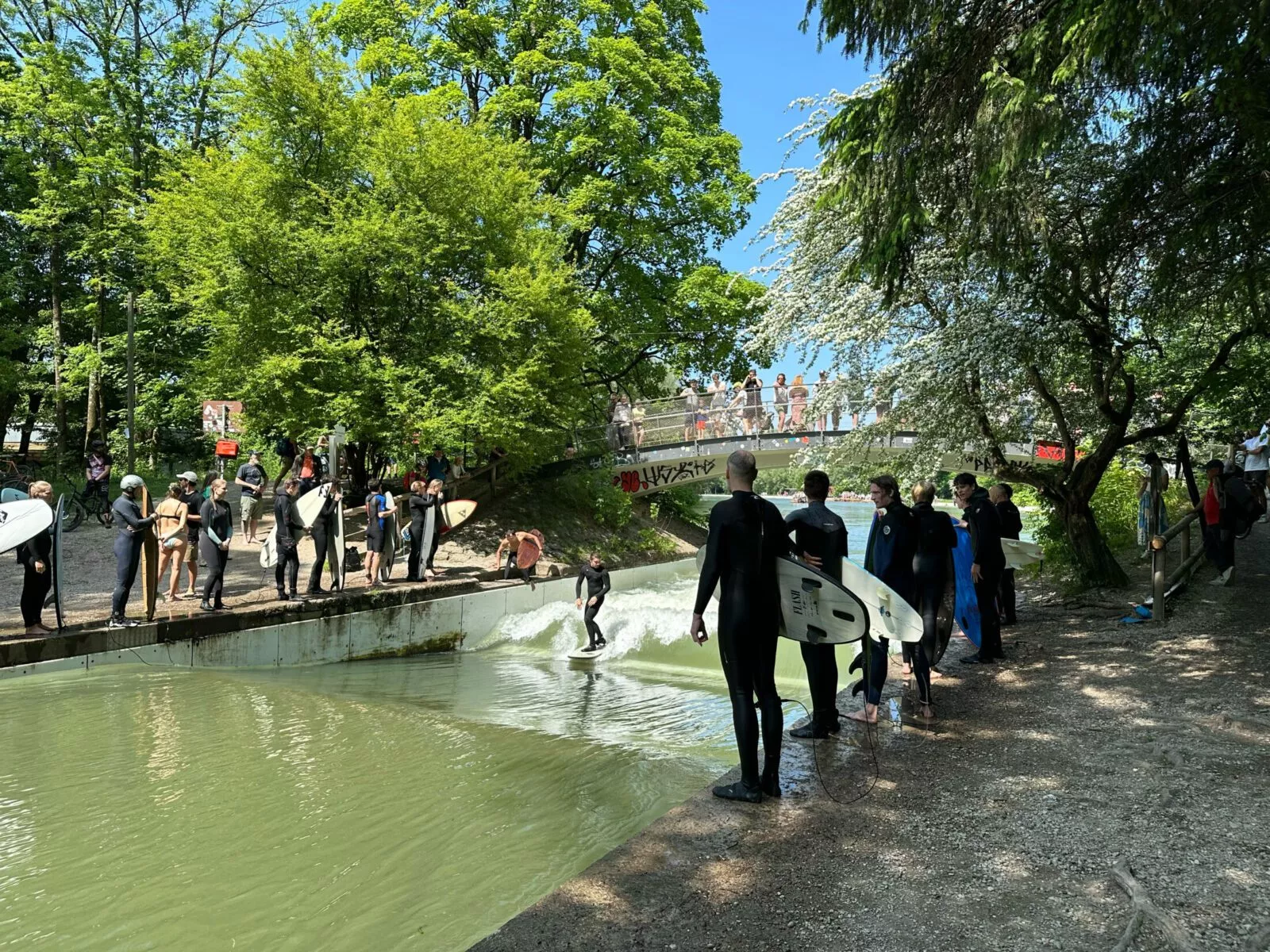
This is the wave Munich is most famous for. The Eisbachwelle München at the entrance of the Englische Garden is a major tourist attraction and the best and most challenging + most competitive wave (Localism – no shit!) of the three river waves in town. Surfers from all over the world come here to surf the famous river wave, even professional ones/world champions like Kelly Slater, Mick Fanning, and Jamie O’Brien have come to surf here.
Eisbach E2 – the longboard river wave
The Eisbach E2 Dianabadschwelle river wave has a long history and since 2014 unfortunately is a very flat wave. But still, it is surfable, ideally with longer boards.
Floßlände
At the Floßlände Munich, river surfing was born in 1972 and so was the rapid surfing of today. The relaxed spot with the big meadow at the Isarkanal is just right for the first attempts on the surfboard. The crowd is very friendly and welcoming, also to beginners. If you are just starting out, you are in good company and won’t feel too intimidated by advanced and competitive river surfers.
Indoor Surfing Jochen Schweizer Arena
The Jochen Schweizer city wave is the first indoor surf wave in Germany. The wave height can be adjusted for all types of levels (beginners, intermediate, advanced, and pro surfers) at ideal water temperatures between 24°C to 26°C. More infos: Indoor Surfing Jochen Schweizer Arena or book your session directly here.
o2 SURFTOWN MUC
With SURFTOWN® MUC, a 20,000 sqm artificial surfing facility has been built just outside Munich in Hallbergmoos that is unique in Europe. Environmentally friendly generated and individually adjustable waves offer a unique sport, training, and leisure experience for families, beginners, and professionals since the opening in 2024. The entire facility is designed to be CO2 neutral and relies on renewable energy and sustainable operation of the facility.
3. What surfboard (length) do I need to surf in Munich?
For surfing the standing/rapid/river waves Eisbach E1, the Floßlände, and Jochen Schweizer Indoor Arena, a board with a maximum length of 5.6 ft. is recommended in order to fit well into the wave (even if you surf a much longer board in the ocean – the difference is you don’t have to paddle into the waves). At the Eisbach E2, a longer board with more volume makes sense to use, as the wave is very flat.
For o2 Surftown MUC, bring your typical ocean surfboard (Shortboard, Fish, Groveler, Midlength, …). The scenario is different than surfing a standing wave. In comparison to rapid/river/standing waves, when surfing moving waves, you usually need a longer board and especially more volume to be able to catch waves by paddling into them.
4. Munich best time to surf
The best time for river surfing in Munich is typically during the spring and summer months when the weather is warmer. To avoid the crowds, some die-hards surf at night and in freezing cold winter-time. The Eisbach River wave is a consistent standing wave located in the English Garden. It can be surfed year-round, although the conditions may vary depending on the water level and flow rate. The wave at the Floßlände usually runs between the end of April / beginning of May until the end of September / beginning of October. Since the city diverts the water for the canal from the energy supply, the times are renegotiated every year. Indoor Surfing at the Jochen Schweizer Arena is possible all year round in warm water temperatures between 24°C to 26°C and also the wave park Surftown MUC offers the opportunity to surf all year round.
Munich Surf Map
5. What to do in Munich besides Surfing?
Munich, the capital of Bavaria in Germany, offers a variety of activities and attractions.
Drinking Beer
Munich is renowned for Oktoberfest and its beer culture and thus is home to several traditional breweries and beer gardens. The city has a rich history of brewing, and beer has become an integral part of its social and cultural fabric. Check out a list of recommended beer gardens below, all situated in Munich’s city center and close to the Eisbach River waves:
Augustiner Keller
Augustiner-Keller, Arnulfstraße, Munich, Germany
Seehaus
SEEHAUS im Englischen Garten, Kleinhesselohe, München, Germany
Parkcafé
Park Café München, Sophienstraße, Munich, Germany
Max-Emanuel Biergarten
Max Emanuel Brauerei - Wirtshaus und Biergarten, Adalbertstraße, Munich, Germany
Biergarten am Chinesischen Turm
Biergarten am Chinesischen Turm, Englischer Garten, Munich, Germany
Explore the city center: Marienplatz and Viktualienmarkt
Visit the heart of the city, Marienplatz, and marvel at the impressive architecture of the New Town Hall. Don’t miss the famous Glockenspiel, which performs a charming show several times a day. Wander through the bustling Viktualienmarkt (right next to Marienplatz), a popular food market in the city center.
Visit the Nymphenburg Palace
Explore the grand Nymphenburg Palace, a Baroque palace surrounded by beautiful gardens. Discover its opulent rooms, the Marstallmuseum (carriage museum), and take a stroll in the extensive park.
Visit Lakes outside of the city
If you love spending time in nature, Munich and its surrounding regions got you covered with its beautiful lakes that offer scenic landscapes and recreational activities.
- Lake Starnberg (Starnberger See): Located only about 25 kilometers southwest of Munich, Lake Starnberg is the lake closest to Munich city. It is surrounded by picturesque villages and offers various water sports, boat trips, and walking trails.
- Ammersee: Situated to the west of Munich, Ammersee is the third-largest lake in Bavaria. It is popular for sailing, swimming, and fishing. The lakeside towns of Herrsching and Diessen offer charming promenades and cafes.
- Lake Chiemsee: Located about 90 kilometers southeast of Munich, Lake Chiemsee is often referred to as the “Bavarian Sea.” It is the largest lake in Bavaria and offers beautiful beaches, boat tours, and opportunities to visit the famous Herrenchiemsee Palace on the island of Herreninsel.
- Walchensee: Situated in the foothills of the Bavarian Alps, approximately 80 kilometers south of Munich, Walchensee is known for its crystal-clear waters and stunning mountain scenery. It is a popular spot for swimming, windsurfing, and hiking.
- Kochelsee: Located around 70 kilometers south of Munich, Kochelsee is another scenic lake nestled amidst the Bavarian Alps. It offers opportunities for swimming, boating, and hiking, and is also known for its rich cultural heritage, including the Franz Marc Museum.
Lake Starnberg
Lake Starnberg, Germany
Ammersee
Ammersee, Germany
Chiemsee
Chiemsee, Germany
Walchensee
Walchensee, Kochel, Germany
Kochelsee
Kochelsee, Germany
Ready for your surf trip to Munich? Get inspired:
These guys have done it before, going to Munich surfing and drinking beer.